LGBTQ+ representation in the media
In this part of my portfolio, I will attempt to analyse how LGBTQ+ culture is portrayed in the media. I will specifically examine the formation of stereotypes of homosexual men in movies, as well as look at places where media has sought to demolish these incorrect notions in the twenty-first century. I will utilise the film Bruno (2009) to describe the constructions of stereotypes among homosexual people and gay culture, and the Campbell Soup Gay Parents Ad to highlight the deconstruction of these stereotypes.
For centuries, media representation as well as stereotyping has been controversial as well as a widely discussed topic. Stereotypes in media material are probably unavoidable since many forums, such as advertising, entertainment, and journalism, require a huge majority of their consumers to swiftly absorb information. Stereotypes are overgeneralizations that assist the audience in gaining a quick and oversimplified picture of a group of people, usually based on such people's ethnicity, gender, sexual orientation, socioeconomic status, or occupation. (Tu and Lee, 2014)
Historically, LGBTQ+ people have had minimal media exposure. Despite the fact that lesbians and gay men have been increasingly visible in the media in recent years, they are still generally seen in restricted or unfavourable roles. LGBTQ+ people continue to be adversely categorised or stigmatised as a minority group, and the mainstream is at least partially to blame. (Tu and Lee, 2014) An example of the constant stereotyping of gay men in the media is the movie called Bruno, which was released in 2009.
The film stars the controversial comedian Sacha Baron Cohen as the flamboyantly homosexual Austrian character Bruno. Various people believe the movie is beneficial to the LGBTQ+ community, while others support the notion that it is harmful to the cause of gay rights. (Bishop, 2010) For example, Aaron Hicklin, editor of Out Magazine, expressed his enthusiasm for the film because as he states it "shows that people's opinions can rapidly change when they find you're homosexual. The multiplex crowd would not ordinarily sit for a two-hour lesson about homophobia, yet that is exactly what will go place. That makes me happy" (Barnes 2009). The LGBT and Lesbian Alliance Against Defamation (GLAAD), on the other hand, said that the video "reinforces negative stereotypes and 'decreases the public's comfort with gay people" (Associated Press 2009).
In my attempt to form an opinion as well as examine the formation of stereotypes of homosexual men I decided to watch the film again. After doing that it was clear that this was a controversial topic. Nonetheless, I was leaning more on the opinion that film actually stereotypes homosexual men and not only that but also it has the potential to harm and stereotype all the LGBTQ+ families and people. This can be clearly seen in the "Talk Show Scene - 'Today with Richard Bey'" as seen below.
(since this is aged restricted video you are redirected to see it in YouTube: https://www.youtube.com/watch?v=wbA6X2Vdx5A)
In this particular scene, gay men are harmed and stereotyped in various ways.
1. Gay men are racist.
In this clip in a particular moment, Bruno the character shows his adopted baby to the crowd and the crowd was negatively reacting because a white man had a black baby. Moreover, when he explains the origins of the baby, the character mistakenly states that Africa is a country and not only that but he also refers to the African people as "African Americans". In doing so the gay character is portrayed as a man who has no respect and knowledge for African (even black) people despite the fact he adopted a black child.
2. Gay men are not meant to be parents.
Adding to the above in the same scene Bruno then was asked how he adopted his son, and his answer was that he swapped him with an iPod. The crowd was then negatively suggesting that the only reason he adopted a kid and more specifically a black kid was to use him to attract other people. Bruno then responded to this by saying he (the kid) is a "dick magnet". These two parts of the one scene of the movie can dramatically stereotype gay men and gay people in general as bad parents or actually as people incapable of being parents and that the only reason they will have kids is for personal gain.
3. Gay men are dangerous and can harm children.
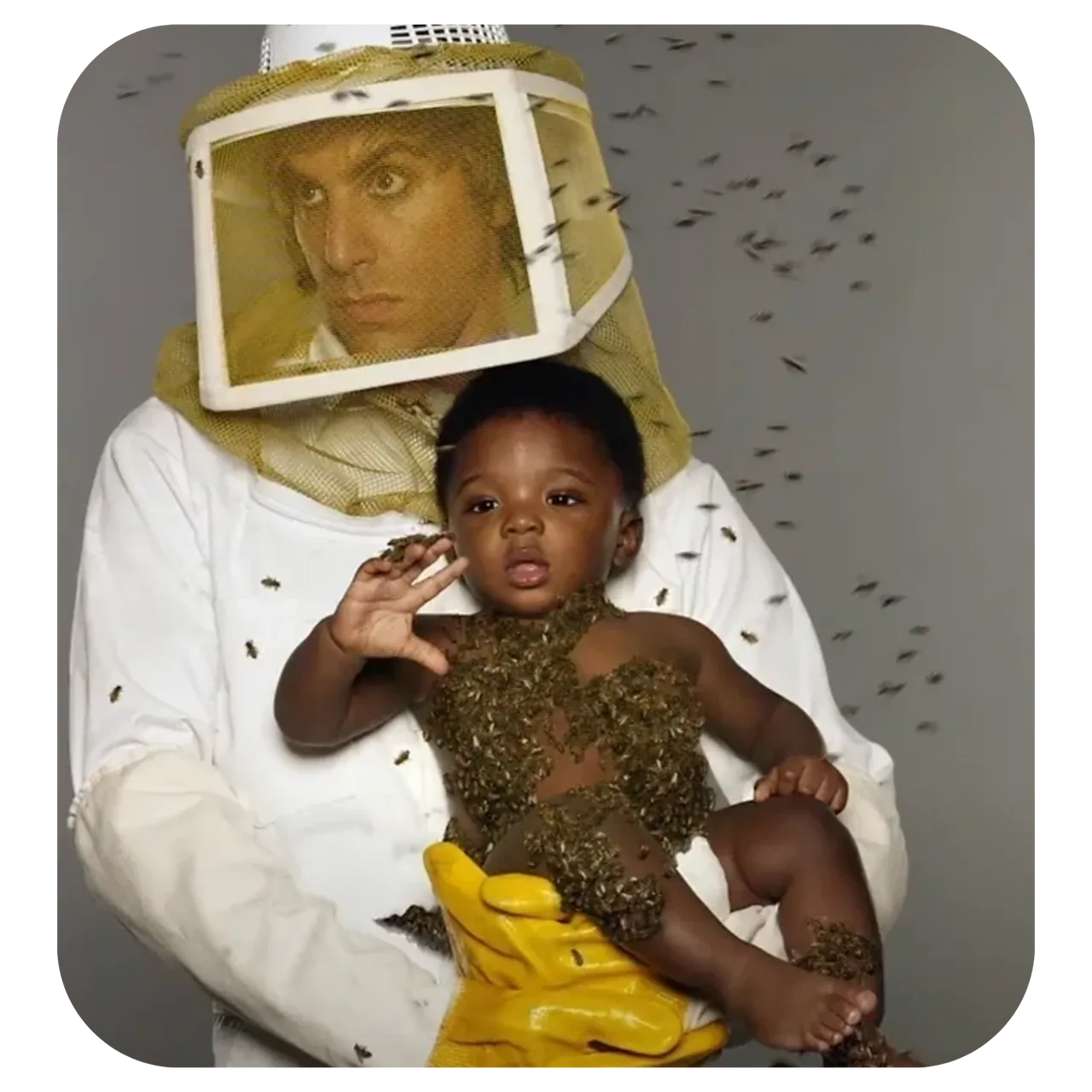
Some moments later in the same scene, a picture of Bruno and his son was shown which you can also see below.
When an individual sees that picture their first reaction will certainly be a very negative one, since it actually shows a child with bees on him while the parent is protected from them. I understand that the intention of the movie is to be a comedy but for a gay person and even more, specifically a gay parent seeing this picture in which gay men are actually showcased to harm a child is not simply a stereotype but a dangerous homophobic symbol stating that gay men will harm children, thus they cannot be parents.
These three stereotypes from simply one scene that were explained above, are just some of the many stereotypes shown in this movie. Despite the fact that this is a comedy, for the majority of the lgbtq+ people, it doesn't feel like one. (Sarkisian, 2020) The reason is that in the movie instead of having the LGBTQ+ community, being on the joke, it feels like we're being mocked, and LGBTQ+ people are again made the punchline. The issue is that this is a comedy aimed solely at heterosexual viewers instead of the LGBTQ+ groups it should have targeted. It elevates heterosexual people's laughter over the LGBTQ+ community as a whole.
Fortunately, throughout the years this phenomenon of stereotyping LGBTQ+ people and in this case, gay men has improved and started to fade away, due to the media's attempt to deconstruct some of these stereotypes. Campbell Soup Gay Parents Ad is a good example of an attempt to promote a product while also deconstructing gay stereotypes.
Deconstruction of the stereotype that gay men cannot be parents
The above advertisement portrays two real-life homosexual fathers. A dad is seen in the advertisement feeding his son the firm's Star Wars-branded chicken noodle soup while saying the classic statement, "I am your father." Shortly later, his husband offers a mouthful of soup to his son and exclaims, "No, no, no." I am your Father." Apart from promoting the soup, the above advertisement also attempts to deconstruct the stereotype that gay men cannot be parents and that a child can only have one dad.
Yin Woon Rani, vice president of marketing activation at Campbell's, stated in a statement (Philadelphia Magazine, 2015):
"At Campbell, we've always believed in the power of food to connect families and bring people together. This commercial is a reflection of the diverse families we serve and support."
In other words, the advertisement also deconstructs the notion of what an American Family is and that actually gay people are part of it.
Summing up I believe that a lot of improvement has been done regarding the deconstruction of gay stereotypes, but we are far from close to fully eliminating these labels and assumptions. Nonetheless, that is okay since every issue that our world is currently facing (racism, sexism, homophobia, stereotyping etc) cannot simply be solved or eliminated instantly. It actually requires time and exposure to the culture of all communities and people to fully comprehend and see the reality. As long as there are signs of progress we will one day reach our destination and in essence, deconstruct reality itself and have full awareness.
References:
- Associated Press. (2009). "GLAAD: 'Bruno' Reinforces Negative Gay Stereotypes". Available at: https://usatoday30.usatoday.com/life/movies/news/2009-07-11-glaad-bruno_N.htm [Accessed 14 May 2022].
- Barnes (2009). "A Plea for Tolerance in Tight Shorts. Or Not." The New York Times.
- Bishop, C. (2010). 'Hey, Hey, He Gay, He Gay . . . Okay' . . . Or Is It?: The Sociological Importance of Bruno. Honors Theses. [online] Available at: https://digitalcommons.bucknell.edu/honors_theses/33/?utm_source=digitalcommons.bucknell.edu%2Fhonors_theses%2F33&utm_medium=PDF&utm_campaign=PDFCoverPages [Accessed 17 May 2022].
- Sarkisian, J. (2020). 9 movies that got their LGBTQ representation completely wrong. [online] Insider. Available at: https://www.insider.com/movies-that-got-lgbtq-representation-wrong-2020-6#bruno-2009-7 [Accessed 18 May 2022].
- Tu, J.-W. and Lee, T.-T. (2014). The Effects of Media Usage and Interpersonal Contacts on the Stereotyping of Lesbians and Gay Men in China. Journal of Homosexuality, 61(7), pp.980-1002. doi:10.1080/00918369.2014.871904.