Diary and cultural encounter

About me:
My name is Antony, a second-year student studying business management. I believe that my experiences are the reason I am here talking to you. I also believe that my identity realisation is the reason I am interested in subjects regarding intercultural communication and that my consciousness is the reason I appreciate the "little" things.
Our world has changed significantly over the last 3 years, and so has mine but in a different context than simply covid-19. I always thought I knew reality until I met myself. I always thought I knew myself until I met reality. You are probably thinking now what that means. Well, let me explain.
Intercultural communication is the communication between individuals from two distinct cultures, (Chen and Starosta, 1998:28) but what about the communication of oneself (one same individual) from two different cultures? In order for me to explain the meaning of this, we have to go back 2 years ago. At that time I was living in the country I was originally from which is called Cyprus. I was that shy person, who always lacked confidence, thus listening to what others think of him. In fact, not only that but I also had the tendency to fully accommodate my identity and language in order to feel a sense of belonging in the particular group and culture I was at that time. This is referred to as the accommodation approach known as convergence by Beebe and Giles (1984:7). It entails adapting one's communication style to match the remainder of the interlocutor's. As Giles (in press) clearly remarked, several people take satisfaction in their ability to speak effectively across encounters, and that is how I felt or thought I was feeling back then. (Pitts and Harwood, 2015) Perhaps this satisfaction derives from a Western concept of "this is who I am," a true sense of "self" that they believe crosses encounters. This notion of stability though is not only likely to be incorrect, but it also commonly leads to unproductive and inappropriate communication (Spitzberg and Cupach, 1984). It would also deprive communication of much of its joy and aesthetic experience; Something I realised at a certain point occurred to me.
It was winter, specifically the month was December, I and the group of people I was calling friends at that time decided to go to a friend's house and have a party as well as stay there for a night and I without question said yes. When we arrived there, everything looked fine, I seemed to be happy (emphasis on "seemed"). After some time and a lot of drinking my constant language and identity, accommodation started to fade away (thanks to alcohol). I felt for a brief time free, and "naked", but then suddenly I felt exposed and uncontrollable fear. I was not that wrong though, since exposing my real self to people who think they know me gave them the chance to label me, as the joker. (but I know I am not a joke). Despite knowing the false label imposed on me on that day, I still accommodated myself to it. The whole night I was the joker. I prefer to be the joker than be exposed and showcase my true self. That actually made me temporarily feel good and safe. Nonetheless when the party finished and the alcohol started to fade away, when I was all alone, without any label, without the "need" to accommodate myself, I started actually crying. I didn't know why, and that made me terrified (but really I knew). Their constant, yet unconscious labelling of me as the joker might be categorized as existentialist; one of Hinton's definitions of 'wrong stereotyping'. More specifically, stereotyping individuals by classifying them by a label, such as in my experience the "joker" (Hinton, 2000). The problem with this technique is that by assigning someone an automatic identification based on their behaviour, it is then simple to attach to them a typical set of traits that are given to the certain label they were classified as. As a result, they forfeit your identity as a distinct person who may or may not match that stereotype. (Reed, 2021) The next phase is to form feelings of bias and discrimination toward those whom we recognize as belonging to their category.
Nonetheless, I do not think it's their fault or mine since culture is such a powerful motivator. Culture is to humans what water is to fish. It is ubiquitous, it is vital, and we utilise it to move ahead and manoeuvre. We cannot move or operate without it, but sometimes we don't detect it.(Christian Muntean, 2016) Everybody is exposed to culture, yet most of us have trouble understanding or articulating it. In reality, we will not notice anything unless something shifts. That night something shifted in me. A great quote that can briefly explain my transformation after that day is Heraclitus's quote:
You can never step into the same river; for new waters are always flowing on you. No man ever steps into the same river twice, for its not the same river as he is not the same man.
The shift was actually the realisation of the culture I was positioned in. The next morning after the party I woke up and saw myself in the mirror and realised that I was actually overaccommodating myself and that was destroying my identity. Then I asked myself what is really my identity and what is the part of my identity I am so terrified of showcasing? That is when as Eckhart Tolle (2004) stated in his book enlightenment came in. He expressly indicated that as you approach maturity, you would have ambiguity about your sexuality, followed by the understanding that you are "different" from others. That can also drive you to dis-identify from socially conditioned patterns of thought and behaviour, thus transforming to a different culture while remaining in the same place. This will immediately elevate your degree of consciousness over that of the unconscious majority. I know that for some people this may sound extreme or it may be controversial, but for me is not even a conversation or a debate, it is actually a memory. It is the memory of that morning after the party. It is the transformation of the culture I thought wanted to belong to, with the one I truly belonged to, with the one that felt like home. Nothing was the same after that night. I was certainly not the same after that night. I remember that the next morning was raining but all I could see is colour and light. It is like a baby opening his/her/their eyes for the first time and truly seeing the world, and truly seeing reality, And that brings me to the thing I stated in the very beginning. "I always thought I knew reality until I met myself. I always thought I knew myself until I met reality." That morning both reality and myself were introduced to me. Part of that self is being a gay man living in a homophobic culture.
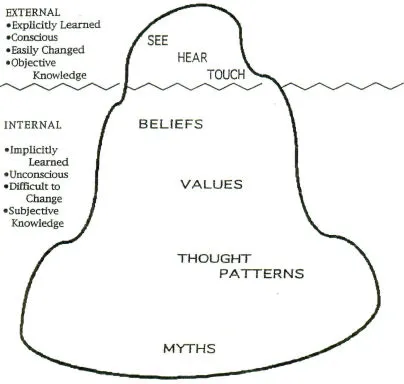
The cultural iceberg: External vs Internal knowledge
It is interesting though the fact that I was actually living in a country which is part of the European Union and where a gay person according to the law has the same rights as heterosexual people; nonetheless as stated above sometimes culture is more powerful than the law itself. Gary Weaver (1986) utilises the concept of an iceberg to convey these many cultural strata (see figure below). Part of a culture, like an iceberg, is visible and easy to recognise and understand. This section contains surface culture as well as parts of folk culture such as the arts, folk dancing, attire, cookery, and so on. However, much as nine-tenths of an iceberg is concealed beneath the ocean, nine-tenths of culture is similarly hidden from view. (Hanley, no date). This out-of-awareness portion of society has been dubbed "deep culture." Deep culture comprises aspects such as the definition of sin, the notion of justice, the term ethic, eye behaviour etc.
In Cyprus that was the big issue, the LGBTQ+ community, as well as other minorities, were and still until this day are facing: The unconscious "deep culture" which condemns anything less "normal"; but what is normal anyway, or let's say who is really normal? The notion of "normal" is perceptive and subjective, and it can signify different things based on the circumstances. When referring to the majority, an individual may use the term "normal"; for instance, someone may be regarded as "normal" by others if they enjoy a specific kind of music that a large percentage of people in that region like. (Avalun Malibu, 2017) In contrast, a person may not be deemed "normal" if they talk in a style that differs from how most people within a particular region communicate. While many people use the term "normal" to describe somebody, something, or a behaviour, "normal" does not actually exist and once I came to that realisation all the pieces of myself came together and formed my true unaccommodating identity. Bringing all the pieces together though is a process.
At first, I started wearing clothes that represented myself. I also started exercising regularly. In other words, I started prioritising myself. The people I was going out with at that time actually noticed that change, they themselves told me that I changed, and I told them it was true but I didn't tell them the whole truth yet. That piece of the puzzle was not ready to be filled/formed yet. After slowly forming my true identity what was once home now shifted to a random place I was once living. As Popova et al (2019) stated in order to have intercultural competence, you must have an aligned connection between language culture and society as they are closely intertwined. That is why I decided to move to the UK and come out to the world as my true self, part of which is me being a gay man, studying business management and then following a career in Marketing. For the first time, all three elements (language, culture and society) as well as my identity were fully aligned and on the same path.
Through these interactions and analyses, I've discovered that it's critical to avoid completely accommodating oneself to satisfy others. Furthermore, it is apparent that culture has a powerful influence on people and what impact living in a certain environment for most of your life can have on your beliefs as well as behaviour towards yourself and others. That is why, to this day, I do not blame those who choose not to accept me for who I am, as they are "blind" to the culture I now live in. As their cultural sight is only towards a specific direction opposite to mine; until it isn't. I know that one day multiculturalism will spread across the world and maybe at that moment all people will see and understand the meaning of identity and culture as well as eliminate the fake notion of what normal is.
References
Avalon Malibu. (2017). Is There Such a Thing as a 'Normal' Person? [online] Available at: https://www.avalonmalibu.com/blog/is-there-such-a-thing-as-a-normal-person/.
Beebe, L.M. and Giles, H. (1984). Speech-accommodation theories: a discussion in terms of second-language acquisition. International Journal of the Sociology of Language, 1984(46). doi:10.1515/ijsl.1984.46.5.
Christian Muntean. (2016). I Can't See What You Are Saying: Why Culture Is So Powerful and How to Shape It. [online] Available at: https://www.christianmuntean.com/i-cant-see-what-you-are-saying-why-culture-is-so-powerful-and-how-to-shape-it/ [Accessed 17 May 2022].
Hanley, J. (n.d.). Beyond the Tip of the Iceberg. [online] Available at: https://pdkmembers.org/members_online/academy/L08-BeyondtheTipOftheIceberg.pdf.
Hinton, P.R. (2000). Stereotypes, cognition and culture. Hove And New York: Psychology Press.
Pitts, M.J. and Harwood, J. (2015). Communication accommodation competence: The nature and nurture of accommodative resources across the lifespan. Language & Communication, 41, pp.89-99. doi:10.1016/j.langcom.2014.10.002.
Popova, O., Golubtsov, S., Grushevskaya, E., Grushevskaya, T. and Zelenskaya, V. (2019). Language, culture, society at the intersection of modern scientific disciplines. [online] Available at: https://www.atlantis-press.com/article/125925279.pdf [Accessed 17 May 2022].
Reed, J. (2021). The Problem With Stereotypes. [online] Medium. Available at: https://medium.datadriveninvestor.com/the-problem-with-stereotypes-90cefda2deaf.
Spitzberg, B.H. and Cupach, W.R., 1984. Interpersonal communication competence (Vol. 4). SAGE Publications, Incorporated.
Tolle, E. (2004). The power of NOW : a guide to spiritual enlightenment. Vancouver, B.C.: Namaste Pub. ; Novato, Calif.
Weaver. Gary R.(1986). Understanding and coping with cross-cultural adjustment Stress. In R.M. Paige (Ed). Cross-cultural orientation. New conceptualizations and applications. Lanham MD: University Press of America.